Find the gaps between AI adoption and business outcomes.
TL;DR
Here’s a question every AI leader should be able to answer: What changed because of your AI investment?
Most enterprises can tell you how much they’ve spent on AI this year. But far fewer can tie that investment to measurable business outcomes.
That gap is the real AI ROI problem. It isn’t that the models don’t work. GPT-class systems, document intelligence engines, and agentic frameworks are demonstrably capable. The real issue is different: these initiatives were never designed to produce a measurable number in the first place.
This blog breaks down why AI ROI fails to scale. It walks through a practical framework for fixing it. And it’s honest about where even good execution can’t save a fundamentally flawed initiative.
AI ROI fails to scale because most initiatives get scoped and funded as technology projects, not workflow redesigns. The pilot is built to prove the model performs. It isn’t built to prove the business runs differently because of it. By the time leadership asks for the ROI number, nobody defined what that number was supposed to be.
That failure shows up in four recurring patterns.
A pilot gets built, demoed, and praised. Then it sits there. It was scoped to prove technical feasibility, not to survive contact with production data, existing systems, or the teams who’d need to use it daily.
Nobody defined a path from “it works in the demo” to “it’s part of how this team operates.” Without that path, most pilots simply stall. This is one of the most common reasons why AI projects fail to convert into measured business value. The project succeeds by its own internal criteria. It still delivers nothing.
Ask most teams what their AI initiative was supposed to move. Cost per transaction? Cycle time? Error rate? Revenue per rep? Often, you’ll get a vague answer about “efficiency” or “innovation.”
If nobody wrote down the number before the build started, there’s no way to credibly claim AI business value afterward, no matter how well the tool performs. Measurement isn’t a reporting exercise you bolt on later. It’s a design decision made on day one.
This is where a lot of enterprise AI adoption strategy quietly caps its own return. Teams automate the easiest step to reach: summarizing a document, drafting a first-pass email, flagging an anomaly. But they don’t touch the workflow around it.
If the intake process is still manual, the approval chain still has five stops, and the downstream system still needs rekeyed data, the AI layer can only save what that one step was worth.
Even a technically sound deployment fails without an owner, a review cadence, and a clear path for feedback to change how the system behaves. Without that structure, usage becomes inconsistent. Some teams lean on the tool; others quietly route around it.
The ROI story becomes impossible to tell cleanly, because the tool was never used the same way twice. Integration and governance aren’t the unglamorous afterthought to an AI rollout. They’re what determines whether the rollout has a defensible ROI story at all.
Fixing AI implementation challenges comes down to four disciplined moves, made in order: define the metric before you build, start narrow and prove one workflow completely, instrument measurement into the system from day one, and design for scale before you scale.
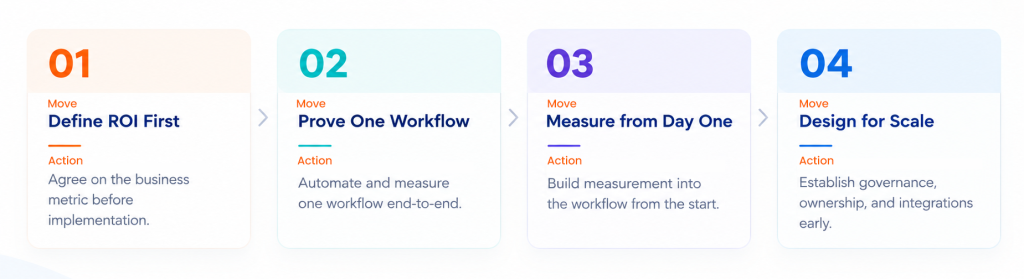
Skip the order, and you risk losing the business case for an initiative that looked promising in the pilot stage.
Before you select a model or engage a vendor, name the number this initiative is supposed to move.
Cost per unit of work. Cycle time. Error rate. Revenue capture. Headcount hours redeployed.
Then get agreement from finance on how it’ll be measured.
This one step resolves most of the ambiguity that later shows up as “we can’t prove this worked.” An AI adoption strategy without a named metric isn’t a strategy. It’s an experiment with no defined success condition.
The organizations seeing the strongest AI ROI typically align technology investments to operational metrics from the outset. That’s why mature AI programs measure throughput, cycle time, exception rates, and productivity improvements alongside model performance.
Five shallow pilots across five departments produce five unconvincing stories. One workflow, automated end-to-end with a measured before-and-after, produces one story finance actually believes, and a template you can repeat with confidence.
In one enterprise deployment we worked on, a premium finance provider used this approach to automate insurance form intake with our agent framework. A process that took roughly three days per claim dropped to about 30 minutes, at 95% accuracy. That’s the kind of number that survives a budget review because it was measured against a defined baseline from the start, not reconstructed after the fact.
The same pattern holds true across document-intensive operations. A leading U.S. insurance distribution platform began with a single contract intelligence initiative, transforming thousands of contracts across 18 contract types into structured business intelligence. By focusing on one high-friction workflow, the organization achieved an 80% reduction in manual contract review effort, 5× faster information retrieval, and 95% extraction accuracy before expanding its broader decision intelligence strategy.
The same pattern appears across successful implementations: solve one workflow completely, establish a measurable outcome, then expand into adjacent decisions and processes.
Instrumentation isn’t a reporting layer you add once leadership starts asking questions. It’s part of the build itself. Log the metric you named in step one from the first day the system touches real work. Don’t backfill it from log files six months later when someone finally asks for a business case.
Tools like Xignifi‘s Document Intelligence, for instance, convert unstructured documents into structured, trackable data as a byproduct of doing the work. The measurement layer exists because the architecture assumes it will be needed, not because someone requested it after the fact.
This approach creates visibility into how work moves through the organization, where bottlenecks emerge, and which decisions generate the greatest operational impact. It also makes it significantly easier to quantify business value as adoption expands.
There’s a gap between “this worked for one team” and “this is embedded in how the business runs.” That gap is almost entirely a governance and integration question, not a technology one. Decide ownership. Define review loops. Set guardrails on autonomy. Map the integration points into existing systems before the pilot even proves out.
That way, a win doesn’t stall in the handoff from the team that built it to the teams that need to run it. This is the same discipline we apply when we help clients move agentic systems from a single measurable use case toward something bigger: a genuine digital brain for the enterprise. That means a connected intelligence layer, not a scattered collection of tools each proving their own small case in isolation.
Organizations that scale successfully treat AI as an operational capability rather than a collection of isolated tools. Decisions, approvals, actions, and outcomes remain connected through governed workflows, creating the foundation for sustainable enterprise-wide adoption.
Comparing the mindset behind stalled AI initiatives with the Xignifi approach driving measurable improvements in speed, accuracy, and efficiency.
|
Pilot Mindset
|
Xignifi Mindset
|
What Changed After Xignifi
|
|---|---|---|
|
Success is a working demo.
|
Success is a measurable business outcome.
|
Organizations achieved up to 94% straight-through processing and 3.4× faster quote generation.
|
|
AI operates as a standalone project.
|
AI is embeddeda into operational workflows.
|
Submission intake, extraction, validation, quoting, and verification operate as a connected workflow rather than disconnected tasks.
|
|
Focus is on model accuracy.
|
Focus is on business performance.
|
Teams process up to 6.8K submissions per day while maintaining 99.1% intake accuracy.
|
|
Measurement is added after deployment.
|
Success metrics are defined upfront.
|
Every workflow is tracked through throughput, processing time, accuracy, and exception reduction metrics.
|
|
Individual tasks are automated.
|
End-to-end workflows are orchestrated.
|
Document extraction completes in under 45 seconds, while validation workflows complete in under 2 minutes.
|
|
Human teams handle most exceptions manually.
|
AI agents resolve routine decisions and escalate when needed.
|
Organizations reduced manual review effort by up to 70% through automated policy verification and validation.
|
|
Governance is considered later.
|
Governance is built into every workflow.
|
Policy and financing decisions maintain 98%+ alignment and verification accuracy, improving auditability and compliance.
|
Even with a strong implementation framework, AI ROI can still be undermined by poor document visibility, disconnected workflows, inaccessible business knowledge, and an inability to turn insights into action. In most organizations, the biggest barriers to ROI aren’t the AI models themselves, they’re the operational gaps surrounding them.
A framework improves execution discipline. It doesn’t eliminate every obstacle to AI ROI. In practice, the biggest risks aren’t usually model-related. They emerge when intelligence remains disconnected from documents, operations, or decisions.
Many organizations deploy AI into workflows where critical business information still lives inside PDFs, contracts, submissions, policies, invoices, emails, and forms.
The result is predictable: teams automate parts of the process while employees continue spending hours searching for information, validating documents, and reconciling data manually.
This is one reason AI initiatives often struggle to scale. The workflow may be automated, but the information feeding it remains inaccessible.
For example:
Document Intelligence addresses this risk by transforming unstructured content into trusted, structured data that downstream systems and AI agents can actually use.
Many AI initiatives focus on automating individual activities while leaving the surrounding process unchanged.
A quoting model may generate recommendations faster, but if submissions still require manual routing, document validation, and policy verification, overall cycle time barely improves.
We’ve seen this challenge across multiple industries:
This creates local efficiency without meaningful business impact.
Operational Intelligence solves this problem by orchestrating the entire workflow, connecting decisions, approvals, validations, and actions into a measurable operational system.
Organizations often possess the information needed to make better decisions.
The problem is that employees cannot find it when they need it.
Policy guidelines, compliance rules, underwriting manuals, SOPs, contracts, historical decisions, and institutional knowledge remain fragmented across repositories.
As a result:
AI ROI suffers because employees still spend time searching for answers instead of acting on them.
Cognitive Intelligence addresses this challenge by providing trusted, conversational access to enterprise knowledge, enabling teams to find answers, validate decisions, and act faster.
Many AI deployments stop at generating insights. They identify risks, surface exceptions, and recommend actions, but execution still depends on a human deciding what happens next. As a result, organizations gain visibility into problems without meaningfully accelerating outcomes. This gap between insight and action is one of the most common reasons AI initiatives fail to achieve their expected ROI.
Across industries, organizations increasingly need systems that can not only identify what should happen, but coordinate the next action.
Examples include:
Agentic AI closes the gap between insight and action by enabling AI agents to execute routine decisions, coordinate workflows, and escalate exceptions when human judgment is required.
Over the last few years, we’ve worked with organizations that invested heavily in AI, only to discover that leadership still couldn’t answer a simple question: What changed because of it? Not what the model predicted. Not how many workflows were automated. What business outcome improved?
The organizations creating measurable AI ROI approach the problem differently. They define success before implementation. They start with a single workflow that matters. They measure outcomes from day one. And they design for governance and scale long before the pilot ends.
At Xignifi, we’ve seen this pattern repeatedly across document-intensive, operationally complex environments. The teams that succeed aren’t necessarily deploying more AI. They’re deploying AI where decisions, actions, and outcomes can be measured against a business objective.
If you’re evaluating an AI initiative that hasn’t delivered the impact you expected, or you’re trying to determine where AI can create measurable value next, our team can help you assess it through an operational lens.
Start with a single, named metric tied to the workflow you're changing. Cost per transaction, cycle time, and error rate are common starting points. To simplify this process, Xignifi provides an AI ROI Calculator that helps teams estimate potential business impact by modeling metrics such as time savings, throughput improvements, manual effort reduction, and operational cost optimization before implementation begins.
It depends on the workflow and how narrowly the initial deployment is scoped. In our experience, organizations typically begin seeing measurable operational improvements within 8–12 weeks of deployment, with ROI becoming more evident within 3–6 months as adoption scales and workflows stabilize.
Adoption measures whether people are using the system. ROI measures whether that use is changing a business outcome. You can have high adoption and unclear ROI, if the metric was never defined. Or you can have low adoption and strong per-use ROI, if the tool is powerful but underused. The two need to be tracked separately.
Governance determines whether a system gets used consistently enough to produce a measurable, repeatable result. Without clear ownership and review loops, usage varies team to team, and the ROI story becomes impossible to isolate. Governance also sets the guardrails that let an organization scale autonomy safely once early results prove out, instead of stalling at "we don't trust it enough to expand it."
The framework scales down as well as up. A narrowly scoped, well-measured single-workflow initiative is often more achievable for a mid-market team, precisely because there's less organizational complexity to design governance around. The real constraint is usually resourcing for the measurement and integration work, not company size itself.