22 Aug Leveraging AI For Efficient Cloud Management
Leveraging AI for Efficient Cloud management
Cloud Inefficiencies
Do you know that by 2025, half of the data in the world (100 zettabytes) will be stored on the cloud? Companies are adopting cloud at a very fast rate, and it includes public cloud, private cloud, hybrid cloud, and multi-cloud models.
Though cloud adoption can spearhead innovation for enterprises, it comes with its own challenges. Three of the most important concerns and challenges with cloud are security (83 percent), managing cloud computing spending (82 percent), and governance (79 percent). Almost 30 percent of the cloud budget goes to waste.
In the initial stage of cloud adoption, it is easier to control, but as companies adopt cloud across the departments, cloud inefficiencies start to crop up. It includes capacity management such as reserved instances or savings plans, visibility and cloud consumption monitoring, and wasting resources like idle compute and unused data.
DevOps cannot anticipate the workloads because of high demands in terms of deadlines and releases which can also result in overprovisioning resources. But AI can help you to manage these.
Managing cloud inefficiencies with AI
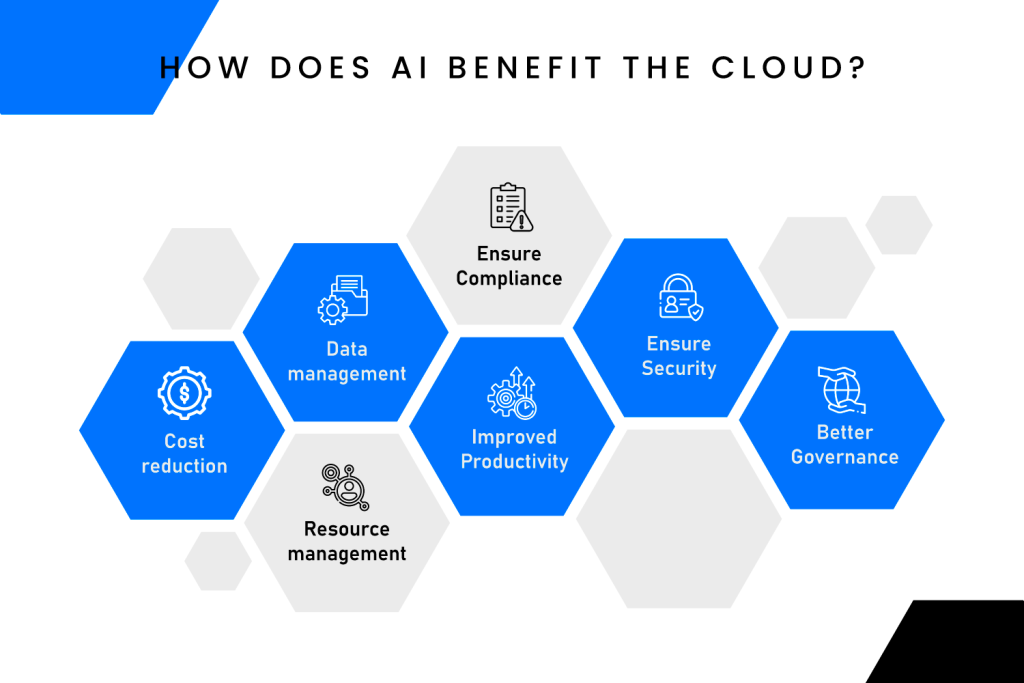
Some of the ways in which AI can benefit the cloud are:
Cost reduction
According to Gartner, companies that are unaware of the mistakes made in their cloud adoption will overspend by 20 to 50 percent.
Autoscaling, unused resources, and dynamic provisioning can be a challenge for cloud finances and strain the cloud budget. But AI and ML can help you bring down the costs by intelligent automation.
For example, by using AI Ops, you can automate the power cycle of development instances to turn them off on the weekend. Another way is to use cloud-specific AI tools like AWS Lambda to automate purchasing process of Amazon EC2 Reserved Instances.
Data management
Collecting, cataloging, and managing data that is generated by businesses is a great challenge. AI tools are being used in specific aspects of data processing. These help in streamlining the processes in which data is ingested, updated, and managed to provide the users with accurate and real-time information.
AI tools can also help in anomaly detection and find fraudulent activities and identify risks. These can have a great impact on industrial sectors like banking, marketing, insurance, customer service, and supply chain management.
Improved productivity
AI is used to automate repetitive tasks and streamline workloads within a cloud environment which in turn increases productivity. The future of the cloud involves AI tools that monitor, manage and auto-correct without human intervention. The growing analytical capabilities of AI will efficiently run routine operations while the IT team focuses on more strategic tasks boosting value.
Better security
Do you know that in 88 percent of cloud breaches, human error is the cause and not cloud providers? Some of the most pressing cloud security challenges include misconfiguration of the cloud infrastructure, unauthorized access, insecure API, hijacking accounts, services, or traffic, and external data sharing. AI can help in 24×7 monitoring and identifying loopholes, security risks and flag them on time.
Ensure compliance
With AI, companies can ensure that every cloud resource is provisioned with the right security compliance configuration meeting the regulatory requirements such as PCI-DSS, GDPR, ISO 27001, and HIPAA.
With AI Ops, companies can use the real-time configuration management data from cloud providers and reduce the business risks by staying compliant. If compliance requirements are not met, it can issue instant alerts to provisioners and even take actions like shutting down machines.
How is AI transforming the cloud?
Industry giants like Microsoft, Google, and Amazon have all their cloud managed services deeply rooted in AI. Cloud has an underlying layer of AI seamlessly running in the background to optimize its performance and also has various AI services to optimize business. Let us take a look at how the fusion of AI and cloud has transformed the cloud.
AI- SaaS Integration
AI in SaaS has been a paradigm-shifting phenomenon. SaaS has leveraged AI for drawing actionable data insights and improved decision making, providing hyper-personalized user experience and much more.
Some of the best examples of AI-SaaS are
Einstein AI from the customer relationship management tool Salesforce. It processes an overwhelming amount of data to identify patterns in customer interactions and improve sales strategies
Another example is the AI-enabled text editor Grammarly which incorporates deep learning and natural language processing to provide real-time language and grammar recommendations to users.
Big data analytics
Deep learning algorithm requires large quantities of data and as the complexity of data increases, the better the algorithms become. Cloud has half of the data in the world on it and a tremendous amount of structured and unstructured data are generated every minute. This big data is a mine of knowledge and AI, and ML algorithms can analyse these data to identify patterns and make predictions.
Integrating AI to the cloud provides more processing power to big data analytics and can help provide insights into complex decision making processes. This can help to eventually streamline delivery services, make accurate predictions, forecast stock portfolios, and make investments wisely.
AI- PaaS
AI PaaS allows teams to build AI applications without the heavy expense of purchasing, managing, and maintaining the required computing power, storage capabilities, and networking.
The pre-trained machine learning and deep learning models in AI PaaS let developers customize or use as-is APIs for integrating specific capabilities such as speech recognition or speech-to-text conversion when building new applications.
Azure ML studio, Amazon Sagemaker, IBM Watson studio, Dataiku, etc. are some of the AI PaaS providers.
Hyper automation
Companies use the principle of hyper-automation to rapidly identify, vet, and automate as many IT processes as possible. It uses intelligence and analytics to scale the automation capabilities and processes of the organization.
The future of AI and Cloud Computing
AI as a Service
AI algorithm requires huge processing power, GPUs and access to large data sets. The integration of AI and cloud is a game-changer and helped businesses overcome the cost barrier making AI more accessible. With AI as a Service (AIaaS) platforms, small businesses can utilize AI by paying monthly costs and scaling up as they need.
The AI services will be able to provide accurate insights into their data, conduct analysis and make decisions without human intervention and deploy processes that add value to the user.
AI Ops
AI and ML algorithms have made dynamic tooling possible which helps in enabling automated alert diagnostic and remediation which can save hours after deployment in handling errors.
AI and ML can be used to automate areas of operations. Some of the benefits of AI Ops are,
- Automated deployments with cluster management and auto-healing tooling.
- Better application performance management to find what, why, and how.
- Efficient log management by live streaming logs and automatic anomaly detection based on the application technology stack.
- Speed up incident management by suppressing noise from different alert systems thereby allowing engineers to find root cause faster.
Cognitive Computing
Cognitive computing combines data mining and analytics, pattern recognition, and natural language processing to create artificial neural networks to imitate the working of the brain. There is a surge in applications that has cognitive capabilities like computer vision, speech, translation, emotion detection, and knowledge mapping. With cognitive computing APIs, we do not have to write code from scratch.
Cognitive computing help make complex decisions when answers are ambiguous. The future of cognitive computing involves real-time language translation, emotion detection for better customer service and even redirecting traffic based on real-time GPS data.
Virtual Assistants
Conversational assistants are one of the most important breakthroughs in AI that is saving a lot of money and manual effort. The conversational bots of today can answer questions and direct calls to the right representatives.
Nuvento’s FNOL chatbot and NuBot AI voice-enabled chatbots can simplify insurance processing and make it easier for both users and agents by assisting them.
With advancements in AI and cloud computing, these bots are getting better at deciphering the nuances of language and providing more accurate responses. The future voice assistants will have natural language understanding capabilities.
Internet of Things (IoT)
Smart machines have already begun to take over our everyday lives. From our smartwatches and appliances to self-driving cars, AI and the cloud are already connecting and managing the smart devices and the tremendous amount of data generated by them.
The AI algorithms are going to get better and become capable of making decisions on their own.
BI
Business intelligence provides insights into the past, present, and future data and the cloud is a large repository of data which makes it an ideal platform for BI applications. Integrating AI helps to strategically use BI budgets, governance of real-time data, automate decision making, and lets applications to adopt changing business requirements as the business evolves.