
TLDR
The call always comes at the worst possible time.
A critical asset has failed. A key customer is escalating. Technicians are rerouted. Overtime is approved. SLA penalties are discussed before the day is over.
And then, in the executive review, the inevitable question surfaces:
Could this asset failure have been prevented?
When the service history is examined, the answer is almost always yes.
Common warning signs include recurring minor faults, aging or over-cycled components, deferred maintenance actions, abnormal usage patterns, and technician notes indicating wear or instability. When analyzed together, these signals often predict failure well in advance.
The warning signs were there, repeated failure patterns, aging components, technician notes hinting at wear. The data existed.
It just wasn’t acted on in time.
That’s the hidden cost of reactive service.
According to McKinsey & Company, predictive maintenance programs can reduce maintenance costs by up to 10–40% and decrease downtime by 30–50% when effectively implemented.
Despite these findings, many field-service operations remain anchored in reactive or calendar-based maintenance models.
In an environment defined by distributed assets, mobile technicians, regulatory compliance, and tightening service margins, reactive models introduce volatility and erode profitability.
The next competitive advantage in field service will not come from expanding headcount or increasing service coverage. It will come from foresight.
Docketry ND4 Failure Prediction Agentic AI enables organizations to anticipate breakdowns before they occur, optimize workforce deployment, and protect service margins, transforming service operations from a cost center into a strategic differentiator.
How does Docketry ND4 Failure Prediction Agentic AI improve SLA performance?
Docketry ND4 Failure Prediction Agentic AI improves SLA performance by detecting early warning signals, such as delayed inspections or recurring minor faults, before they escalate into SLA breaches. This allows service teams to intervene earlier, plan coordination proactively, and prevent last-minute escalations.
Most field-service organizations already maintain extensive operational datasets:
Yet maintenance planning often remains driven by static service intervals or customer-triggered complaints.
This misalignment produces systemic inefficiencies:
A study by Gartner has emphasized that organizations failing to leverage operational analytics will face increasing cost pressure as service complexity grows. In particular, Gartner notes that predictive asset management is becoming foundational to next-generation service models.
The challenge is not a lack of data. It is the inability to convert historical records into forward-looking intelligence.
Nuvento Docketry has been designed to operationalize Failure Prediction AI Modelling & Intelligence within distributed service ecosystems. Rather than functioning as an isolated analytics dashboard, its Failure Prediction AI capability integrates directly into service workflows, ensuring that insights drive actions.
Each asset is continuously evaluated using historical breakdown patterns, usage intensity, environmental variables, and replacement cycles. Technician observations are incorporated into the Agentic AI model to enhance contextual precision.
The outcome is a dynamic failure probability score at the asset level. Service managers can prioritize interventions based on measurable risk indicators rather than uniform schedules.
This shifts preventive maintenance from routine activity to targeted, data-driven action.
Reactive dispatching creates operational volatility. Emergency assignments disrupt planning, increase fuel and labor costs, and strain technician availability.
By embedding Docketry ND4 Failure Prediction Agentic AI into dispatch workflows, organizations can:
When predictive intelligence informs dispatch, workforce deployment becomes structured rather than reactive, reducing unnecessary truck rolls and improving overall productivity.
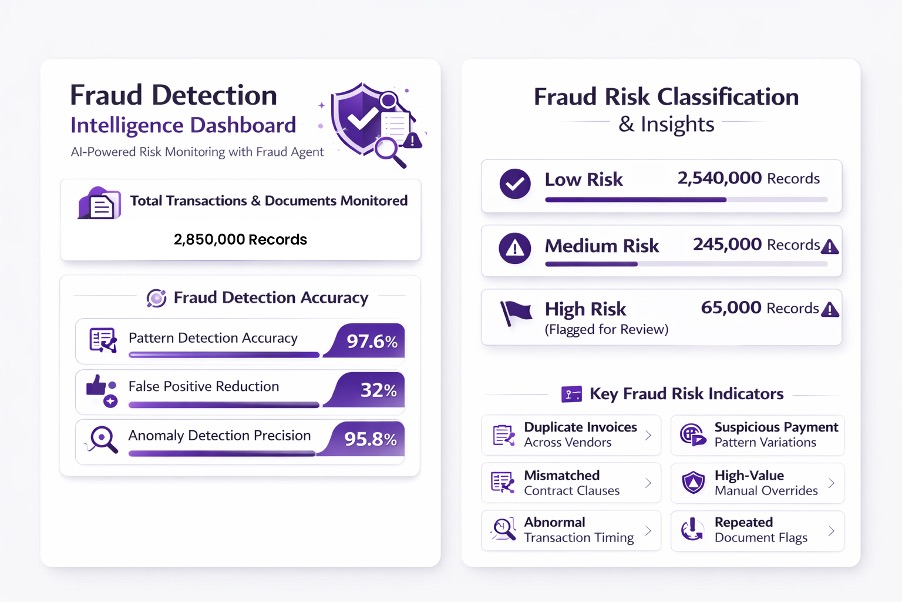
Fraud exposure is one of the most underestimated margin leakages in modern enterprises.
Unchecked anomalies drain revenue & margins.
False positives consume investigation bandwidth.
Delayed detection increases regulatory exposure and reputational risk.
Traditional rule-based fraud controls often create two costly extremes: either too many alerts that overwhelm compliance teams, or too little precision that allows sophisticated fraud patterns to go unnoticed.
Agentic AI Predictive Fraud Modelling & Intelligence further changes this equation.
Instead of reacting to confirmed fraud cases, Agentic AI-driven models analyze transaction behaviours, document inconsistencies, vendor patterns, approval workflows, and anomaly clusters in real time. The Fraud Detection Agent anticipates risk signals before financial impact escalates, enabling compliance and risk teams to prioritize intervention strategically.
The impact is tangible:
Fraud management shifts from reactive investigation to proactive risk orchestration.
When Agentic AI Predictive Fraud Intelligence becomes embedded in your control environment, risk is not merely detected, it is anticipated, prioritized, and contained before it affects financial performance.
Docketry ND4 Failure Prediction Agentic AI directly influences the core performance indicators that define field-service profitability:
Even modest reductions in emergency interventions generate compounding financial impact. Lower overtime, fewer expedited shipments, optimized routing, and minimized SLA penalties collectively drive margin expansion.
Predictive AI capability stabilizes operations.
Stability improves financial forecasting.
Improved forecasting strengthens strategic planning.
Many organizations experiment with Failure Prediction Agentic AI but fail to scale. The barrier is rarely technology; it is integration.
Successful predictive transformation requires:
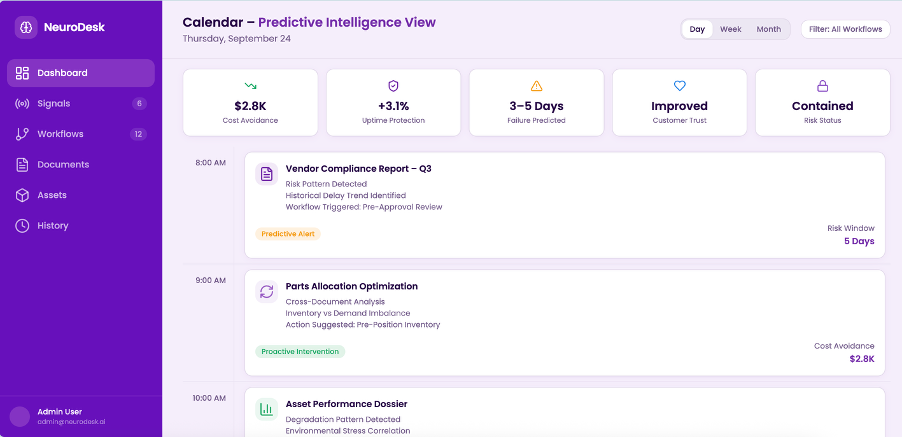
Docketry addresses this integration challenge by embedding Failure Prediction Agentic AI intelligence directly into operational decision-making environments. In our Agentic AI platforms like Neurodesk, insights are not confined to dashboards, they inform, plan, and SLA monitor in real time, and address the issues beforehand.
This ensures Docketry ND4 Failure Prediction Agentic AI Intelligence evolves from experimentation to sustained enterprise capability.
If your organization is evaluating how to:
It is time to assess how Failure Prediction Agentic AI intelligence can be systematically embedded into your field operations.
Docketry enables field-service leaders to convert operational data into actionable foresight, transforming service delivery from reactive intervention to proactive advantage.
Connect with our team to explore how Docketry ND4 Failure Prediction Agentic AI intelligence can elevate your service organization into a measurable competitive differentiator.
Common warning signs include recurring minor faults, aging or over-cycled components, deferred maintenance actions, abnormal usage patterns, and technician notes indicating wear or instability. When analyzed together, these signals often predict failure well before the asset actually breaks down.
Failure Prediction Agentic AI improves SLA performance by identifying early operational risks such as delayed inspections, recurring service issues, or abnormal asset behavior. This allows service teams to intervene earlier, preventing SLA breaches and reducing last-minute escalations.
Traditional maintenance either reacts to failures or follows fixed schedules. Predictive maintenance uses operational data, historical patterns, and AI models to estimate failure probability and prioritize interventions before disruptions occur.
Failure prediction systems typically analyze service tickets, inspection reports, asset performance histories, technician notes, parts replacement cycles, and operational logs to identify patterns that signal potential failures.
Many organizations collect large volumes of operational data but lack systems that convert historical records into actionable insights. Without predictive intelligence, valuable signals remain hidden within reports, service logs, and maintenance records.
Agentic AI introduces autonomous monitoring and predictive analysis into service workflows. Instead of reacting to failures, AI agents continuously analyze asset behavior, operational signals, and service patterns to anticipate risks and recommend corrective actions.
Predictive failure intelligence can reduce unplanned dispatches, improve first-time fix rates, lower overtime costs, optimize technician utilization, and strengthen SLA compliance while protecting service margins.
Discover how predictive failure models and Agentic AI help enterprises prevent issues before they occur and build self-optimizing operations.
You can see how this popup was set up in our step-by-step guide: https://wppopupmaker.com/guides/auto-opening-announcement-popups/