
TL;DR
Managing hard-to-value assets has never been just about underwriting. As insurers handle more specialty risks, the real challenge lies in coordinating the growing volume of appraisal reports, inspection records, broker communications, and supporting documents that drive every decision. While document management and workflow automation have improved efficiency, many operations teams still spend valuable time preparing information instead of evaluating risk. The opportunity isn’t simply to manage documents better, it’s to transform fragmented information into operational intelligence that helps decisions happen faster.
Insuring a hard-to-value asset is rarely straightforward. Unlike standard risks that rely on structured information and predictable workflows, hard-to-value assets often require multiple valuation reports, inspection documents, broker communications, photographs, compliance records, and supporting evidence before an underwriting decision can be made. Whether the asset is fine art, luxury real estate, specialty equipment, collectibles, yachts, or other unique property, every submission brings its own set of complexities.
As insurers grow their portfolios, these complexities multiply. More submissions mean more documents, more stakeholders, and more operational coordination. While underwriting expertise remains critical, many delays occur long before an underwriter reviews a file. Teams often spend significant time searching for information, validating records, reconciling discrepancies, and ensuring that submissions are complete. As a result, scaling hard-to-value asset operations becomes less about evaluating risk and more about managing information efficiently.
One of the biggest challenges in hard-to-value asset insurance is the sheer volume of unstructured information involved in every submission. Valuation reports, appraisals, inspection records, financial documents, photographs, broker emails, and policy records often arrive through different channels and in different formats. Before any decision can be made, someone must gather, organize, and interpret this information.
This is where Intelligent Document Management creates measurable value. Rather than treating documents as static files stored in a repository, intelligent systems automatically classify, extract, organize, and connect information across multiple sources. Teams gain access to relevant information without spending hours searching through emails and attachments. By transforming documents into usable intelligence, insurers can significantly reduce operational friction and accelerate decision-making.
For organizations handling growing volumes of hard-to-value asset submissions, Intelligent Document Management becomes more than a productivity tool. It becomes a foundation for operational scalability.
Many insurers have already invested in Insurance Document Management platforms to centralize records and improve accessibility. These systems play an important role in governance, compliance, retention, and information retrieval. They ensure that documents are stored correctly and can be accessed when needed.
However, accessibility alone does not solve execution challenges. A document may be available instantly, but employees still need to determine whether the information is complete, whether supporting records align, and whether additional documentation is required. In hard-to-value asset operations, decisions rarely depend on a single document. Instead, they require information to be connected across multiple records and systems.
This is why insurers often discover that document storage has improved while decision cycles remain unchanged. The issue is no longer finding documents. The issue is transforming information into action.
Over the last decade, insurers have invested heavily in Insurance Workflow Automation to improve operational efficiency. Tasks can be routed automatically, notifications can be triggered instantly, and approvals can move through predefined workflows without manual intervention. These capabilities have undoubtedly improved productivity and reduced administrative effort.
Yet many organizations continue to experience delays because workflows still depend on people gathering and validating information before work can progress. A workflow can move a task from one person to another, but it cannot always determine whether the information required for a decision is complete, accurate, and ready for review.
This distinction is important. Workflow automation accelerates movement. It does not necessarily accelerate decisions. To scale hard-to-value asset operations effectively, insurers need intelligence that can evaluate and coordinate information before it enters the workflow.
Every hard-to-value asset process begins with a submission. Unfortunately, many submissions arrive incomplete, fragmented, or spread across multiple channels. A broker may send supporting documentation separately from appraisal reports. Inspection records may arrive days later. Critical information may reside in different systems altogether.
This creates a hidden operational burden. Before an underwriter can begin evaluating risk, operations teams must gather information, identify missing requirements, and validate data across multiple sources. The review process becomes dependent on preparation work rather than expertise.
Insurance Submission Management addresses this challenge by ensuring that submissions are complete, structured, and decision-ready before they reach reviewers. Intelligent systems can identify missing information, validate incoming documents, classify records automatically, and prepare submissions for evaluation. As a result, underwriters spend less time preparing to make decisions and more time applying their expertise.
As hard-to-value asset portfolios expand, insurers cannot rely indefinitely on manual coordination to scale operations. The volume of information continues to grow, customer expectations continue to rise, and operational teams are expected to deliver faster outcomes without proportional increases in staffing.
This is where Insurance Decision Automation is becoming increasingly valuable. Decision automation combines business rules, operational intelligence, AI, and contextual data to support faster and more consistent decision-making. Instead of requiring employees to gather information before evaluating a submission, intelligent systems can assess available data, identify exceptions, prioritize workloads, and recommend next actions automatically.
The goal is not to replace underwriters or domain experts. The goal is to remove the administrative effort that prevents them from focusing on higher-value work. By reducing manual coordination, insurers can improve both speed and consistency across hard-to-value asset operations.
The emergence of Agentic AI is accelerating the shift from document-centric operations to decision-centric operations. Unlike traditional automation tools that perform predefined tasks, agentic systems actively work toward business objectives. They can gather information, validate documents, identify gaps, escalate exceptions, trigger follow-up actions, and coordinate operational workflows without constant human intervention.
For hard-to-value assets, this capability is particularly powerful because operational complexity often comes from coordination rather than underwriting itself. Agentic systems reduce the invisible work required to move information across teams and systems. Instead of asking employees to connect the dots manually, intelligent agents help orchestrate the entire process.
The result is a more efficient operating model where information flows naturally toward decisions rather than waiting for people to assemble it.
The most successful insurers are no longer asking how they can automate another task. They are asking how they can accelerate decisions.
A Decision Intelligence approach combines Intelligent Document Management, Insurance Workflow Automation, Insurance Submission Management, Insurance Decision Automation, and Agentic AI into a unified operating model. Rather than treating documents, workflows, and decisions as separate functions, it connects them into a continuous process where information becomes intelligence and intelligence becomes action.
This approach enables insurers to manage larger portfolios of hard-to-value assets without increasing operational complexity. Teams spend less time coordinating information, customers receive faster responses, and organizations gain the ability to scale efficiently while maintaining governance and compliance. In an increasingly competitive insurance landscape, the ability to make better decisions faster is becoming one of the most important differentiators.
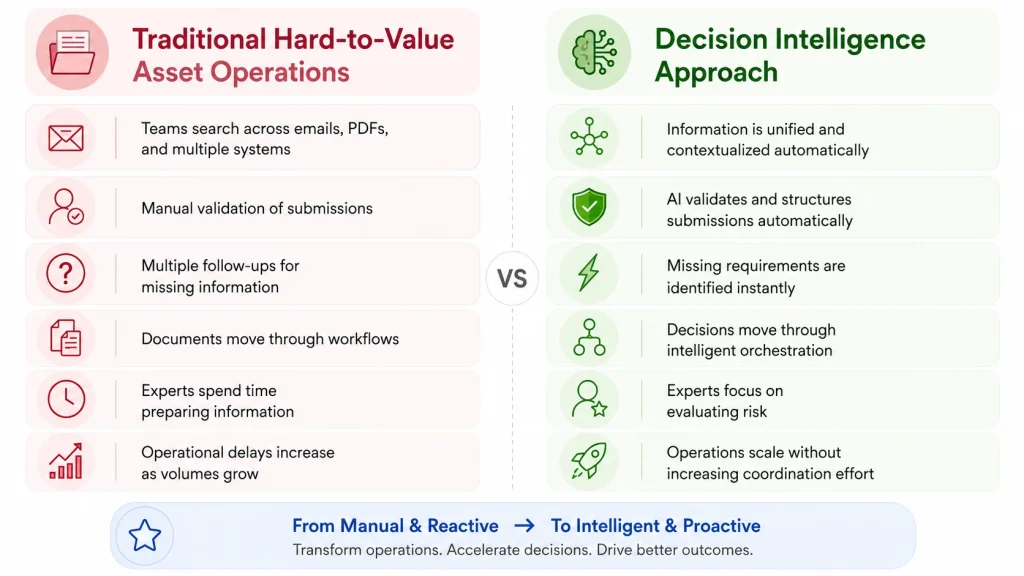
Hard-to-value asset operations should not depend on manual document coordination and fragmented workflows. By combining Intelligent Document Management, Insurance Submission Management, Insurance Workflow Automation, Insurance Decision Automation, and Agentic AI, insurers can transform complex submissions into operational intelligence that drives faster decisions and better business outcomes.
Transform fragmented information into operational intelligence.
Talk to our experts and discover how Nuvento can help you scale hard-to-value asset operations with confidence.
A hard-to-value asset is an asset that requires specialized appraisal, valuation, or underwriting because its value cannot be determined using standard methods. Examples include fine art, collectibles, yachts, luxury vehicles, specialty equipment, and high-value commercial properties.
Intelligent Document Management uses AI and automation to classify, extract, organize, and connect information across documents, helping insurers reduce manual effort and improve operational efficiency.
Insurance Submission Management helps insurers validate, structure, and prepare submissions before review, ensuring underwriters receive complete and decision-ready information.
Insurance Workflow Automation automates repetitive tasks, routing, approvals, and notifications, reducing manual effort and helping organizations improve efficiency.
Insurance Decision Automation uses business rules, AI, and operational intelligence to support faster and more consistent decision-making across insurance workflows.
Agentic AI helps gather information, validate documents, identify missing requirements, coordinate workflows, and recommend next actions, reducing operational friction and accelerating decisions.