
TL;DR
A few weeks ago, we were speaking with an operations leader at a large insurance organization. What began as a conversation about AI quickly shifted to something far less exciting but far more revealing: a financing approval that had been delayed. The delay wasn’t caused by a complex risk assessment, a lack of expertise, or missing information. Instead, teams were spending valuable time trying to bring together data scattered across multiple systems before anyone could confidently move the process forward.
That conversation reflects a reality we continue to see across the insurance industry. Insurers are investing heavily in intelligent automation, cloud modernization, analytics, and AI initiatives. Yet many premium financing teams still spend hours validating information, coordinating across departments, and waiting for critical data to arrive in the right place at the right time. The challenge isn’t a lack of technology. It’s that most premium financing operations were designed around moving information through workflows rather than accelerating decisions.
Before discussing operational challenges, it’s important to understand the role of insurance premium financing. Insurance premium financing allows businesses and individuals to spread the cost of insurance premiums over time instead of paying the full amount upfront. This approach is especially common in commercial insurance and HNW life insurance programs, where premiums can be substantial and preserving liquidity is often a strategic priority.
For insurers, brokers, and financing providers, insurance premium financing creates flexibility for customers while enabling broader access to coverage. However, it also introduces additional approvals, documentation requirements, compliance reviews, and financing decisions that must be managed efficiently. As premium financing volumes continue to grow, so does the complexity of coordinating these processes, making operational efficiency increasingly important.
Over the last decade, insurers have invested heavily in insurance workflow automation. Documents can move faster, tasks can be routed automatically, and notifications can be triggered without manual intervention. These improvements have delivered measurable benefits and helped streamline many operational processes.
However, one critical dependency remains unchanged. People still spend a significant amount of time coordinating information before decisions can be made. Consider a typical insurance premium financing request. Customer information may reside in one platform, policy details in another, supporting documentation in a separate repository, and compliance reviews in yet another system. For organizations managing large broker networks, information may also pass through insurance broker management platforms before reaching financing teams.
While the workflow itself moves efficiently, the information needed to support decisions does not always move with it. Employees often become the bridge connecting systems, teams, and processes, spending time gathering, validating, reconciling, and verifying information before a financing decision can move forward. This hidden coordination effort is where many delays originate.
Premium financing teams spend significant time coordinating data because critical information is often distributed across multiple systems, departments, and documents. Before a financing request can be approved, employees must ensure that information is complete, accurate, compliant, and aligned with business rules, creating delays that compound throughout the process.
What makes this challenge particularly difficult is that the costs are rarely visible. Executives can easily measure approval times, operational expenses, and productivity metrics, but they often cannot see the countless small coordination activities happening behind the scenes. A missing document may trigger a follow-up, a policy detail may require verification, or a customer record may need confirmation before a request can move forward.
Individually, these activities may only consume a few minutes. Collectively, however, they can add hours, or even days, to a financing process. At Nuvento, we’ve found that many insurers don’t necessarily have an efficiency problem. They have a coordination problem. The operational effort required to connect information across systems continues to grow, even as organizations invest in more advanced technology.
This challenge is becoming increasingly expensive. Customers expect near-instant responses, brokers demand faster turnaround times, regulators require greater transparency, and leadership teams are under pressure to improve productivity without continuously increasing headcount. The traditional operating model simply wasn’t designed for this level of speed and complexity.
Many insurers have already invested in insurance document management systems to centralize records and improve accessibility. These platforms play a vital role in storing, organizing, retrieving, and governing information across the enterprise. They help ensure documents are available when needed and support compliance requirements.
However, accessibility alone doesn’t guarantee execution. A financing request can still stall even when every required document exists and is readily available. Employees often need to review, validate, compare, and connect information across multiple sources before they can confidently make a decision. In other words, information management solves accessibility, while decision management solves execution. Understanding the difference is critical for organizations seeking to improve operational performance.
The most successful insurers we work with are beginning to shift their focus. Instead of asking how they can automate another task, they are asking how they can accelerate decisions. This distinction matters because tasks don’t create business outcomes, decisions do. A workflow can route information from one place to another, but a decision determines whether a financing request is approved, whether a risk is acceptable, or whether an exception requires escalation.
This is where Decision Intelligence changes the equation. Decision Intelligence combines business rules, operational context, data, and AI to help organizations determine the best next action faster and more consistently. Rather than requiring employees to gather information before making a decision, intelligent systems can evaluate available data, identify missing elements, assess risks, and guide actions automatically.
The result isn’t simply faster workflows. It’s faster decision-making. And increasingly, that ability to make informed decisions quickly and consistently is becoming a significant competitive advantage for insurers.
The rise of Agentic AI is accelerating this transformation even further. Unlike traditional AI systems that generate recommendations when prompted, agentic systems can actively pursue business objectives by gathering information, validating documents, identifying missing data, escalating exceptions, triggering follow-up actions, and recommending the next best decision.
This capability allows organizations to reduce their dependence on manual coordination while maintaining appropriate oversight and governance. Rather than spending time searching for information or managing administrative tasks, experts can focus on judgment, customer engagement, and strategic decision-making.
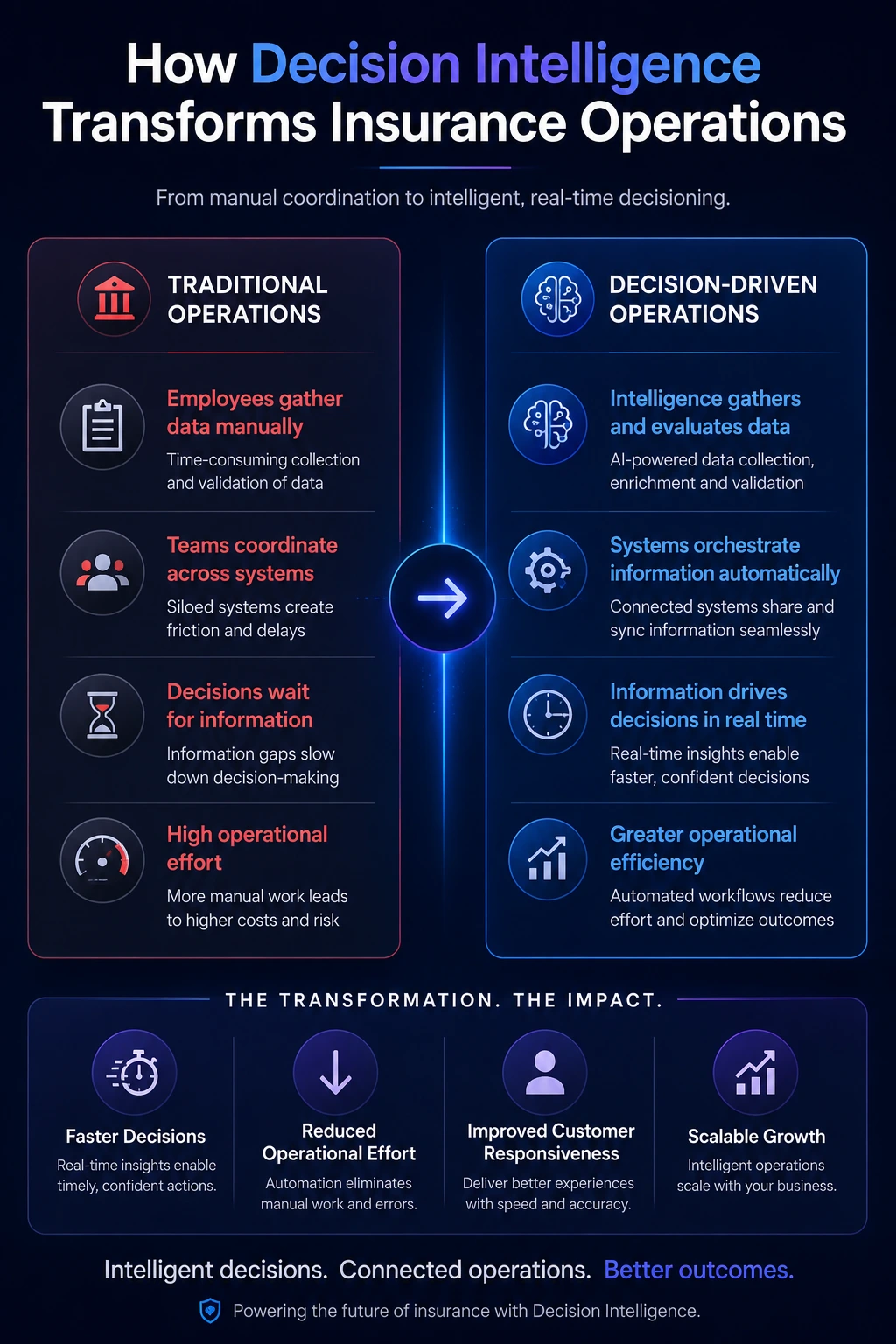
This shift is also changing the role of modern premium finance software. Instead of functioning solely as a system of record, intelligent platforms are increasingly becoming systems of decision support. The difference may seem subtle, but it is transformative. One model depends on people coordinating information. The other depends on intelligence orchestrating decisions.
Over the years, we’ve worked with insurers that invested heavily in automation, cloud modernization, analytics, and AI. On paper, these organizations appeared well-positioned for operational excellence. They had access to the right data, experienced teams, and clearly defined business rules.
Yet when we looked more closely at their premium financing operations, a different story emerged. Teams were still spending valuable time tracking down information, validating documents, and coordinating across systems before decisions could move forward. The challenge wasn’t a lack of information. The challenge was transforming information into action quickly and consistently.
That insight shaped the thinking behind Xignifi. We didn’t set out to build another workflow tool or another dashboard. Instead, we envisioned a Decision Intelligence platform that helps insurers orchestrate decisions across systems, people, and processes. By combining Agentic AI, intelligent orchestration, and decision-centric operations, Xignifi helps organizations reduce manual coordination and accelerate business outcomes.
Because in premium financing, competitive advantage doesn’t come from having more data. It comes from making better decisions faster.
By combining Decision Intelligence, Agentic AI, and intelligent orchestration, insurers can eliminate the operational friction that continues to slow down financing processes today. From our perspective at Nuvento, that’s the next evolution of insurance operations. Not more workflows. Not more dashboards. A smarter way to make decisions.
Insurance premium financing allows businesses or individuals to spread the cost of insurance premiums over time through financing arrangements instead of paying the full premium upfront.
Delays often occur because information is distributed across multiple systems and teams, requiring manual validation, reconciliation, and coordination before decisions can be made.
Decision Intelligence helps organizations evaluate data, business rules, and operational context automatically, enabling faster and more consistent financing decisions.
Insurers can improve efficiency by reducing manual coordination, automating decision-making, connecting disconnected systems, and implementing Decision Intelligence platforms that accelerate operational outcomes.
Premium financing teams shouldn’t spend their day searching for information that already exists. With Xignifi, insurers can combine Agentic AI and Decision Intelligence to accelerate approvals, reduce operational friction, and improve customer experiences.
Explore how Xignifi can help your organization move from workflow automation to intelligent decision execution.